
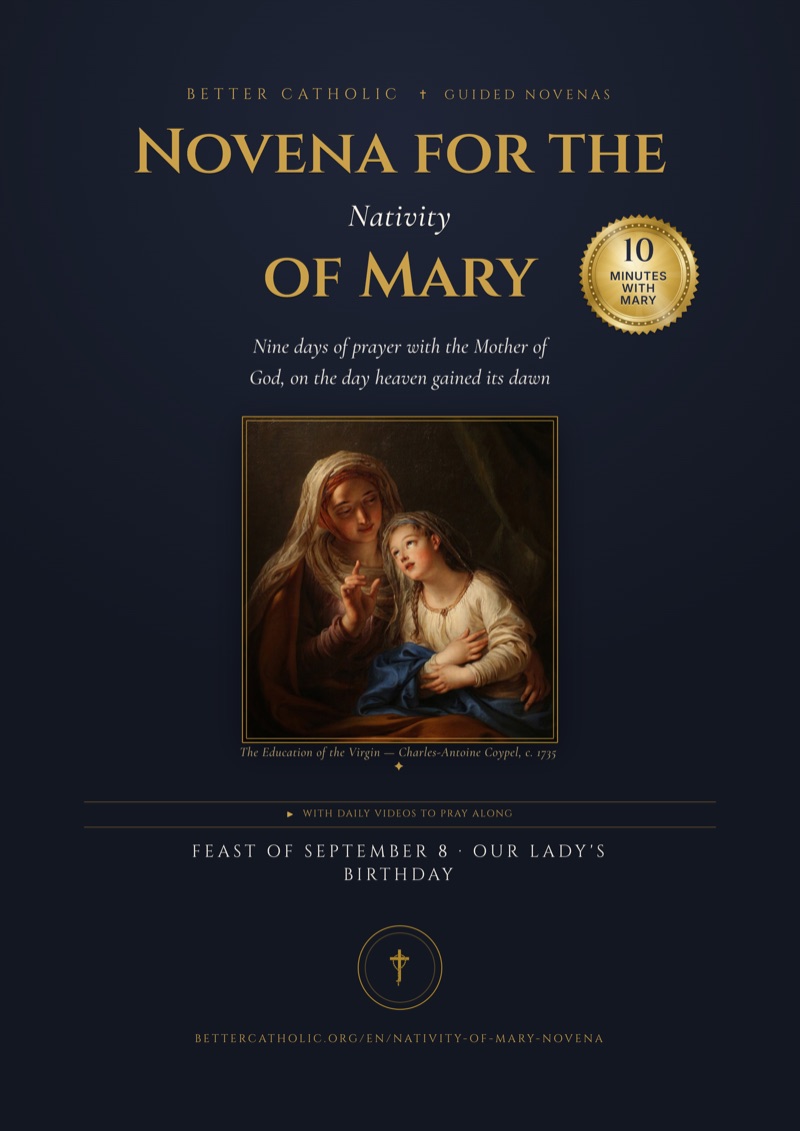
The Church celebrates only three births in the whole year: the birth of Jesus, the birth of St. John the Baptist — and the birth of Mary, on September 8.
This feast was not invented yesterday. It was born in Jerusalem more than fifteen hundred years ago: around the year 450, Christians built a church over the ground tradition pointed to as the home of Joachim and Anne, Mary’s parents, beside the pool of Bethesda — the "Basilica of Saint Mary where she was born", which still stands today as the Church of Saint Anne. In the seventh century the feast reached Rome, and Pope Sergius I honored it with a great procession. And there is a hidden beauty in the calendar: September 8 falls exactly nine months after December 8, the Immaculate Conception. Before the Sun rises, the dawn is born.
The novena we pray here has a named source: it comes from "Mary, Help of Christians" by the Franciscan friar Fr. Bonaventure Hammer, O.F.M. (Benziger Brothers, 1909, now in the public domain), with nine meditations and nine prayers, one for each day — and the preparatory prayer of that novena was enriched with an indulgence by Pope Pius IX in 1863. We translated it faithfully from the original, and the book states, prayer by prayer, what is traditional text and what is our own writing.
Each day has a contemplative video of about 10 minutes with the complete novena: the Sub Tuum Praesidium — the oldest known Marian prayer —, the day’s prayer, the Our Father, Hail Mary and Glory Be prayed in full, the Word of God with a meditation, the Way of the Day, and the closing blessing with the invocation "Our Lady of the Nativity, pray for us!" — nothing abridged, so you can pray along from beginning to end.
On September 8, the feast: many Catholic families celebrate the birthday of the Mother of Heaven with a flower before her image, a lit candle and "happy birthday" sung with the children. The companion book in PDF carries the complete novena, the Prayer Booklet, and a QR code for each day that leads straight to the video.
“Mary was born a saint, and a great saint.”
With that certainty of St. Alphonsus the novena begins: when this child is born, salvation is at the door. Nine days to contemplate the birth that brought joy to the whole world — and to reach September 8, Our Lady’s birthday, with a petition made, renewed and offered.
Not just a prayer to repeat: it is the birthday gift you prepare for the Mother of God, one day at a time.
The novena of Fr. Hammer (1909), with the Sub Tuum Praesidium, each day’s prayer, the Our Father, Hail Mary and Glory Be in full — and the preparatory prayer indulgenced by Pope Pius IX in 1863.
Each day opens with a chapter: Joachim and Anne, the child born a saint, the daughter of kings, the gifts God gave her, the angels who rejoice, the holy name of Mary.
In its first pages the book sets out the research into the sources: what is traditional text, what is our own writing — and what is ancient tradition that is not Scripture, stated in so many words.
A contemplative video each day and the novena book in PDF, with the Prayer Booklet (Litany of Loreto, Ave Maris Stella) and a QR code — made to be printed and prayed in a group.
“Novena of the Nativity of Mary” — in Kindle and paperback editions.
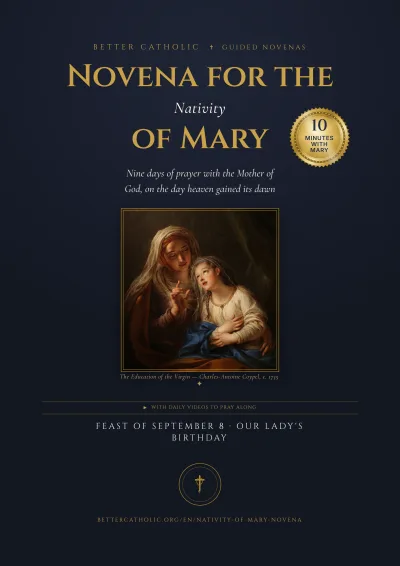 Kindle eBook
The best format for digital reading — take it anywhere. No zooming or dragging pages: the text flows, fits your screen and remembers where you stopped.
Buy on AmazonPaperbackPray with the book in your hands, one day at a time — write your Way of the Day by hand and pray it with your family or prayer group.
Buy on AmazonAs an Amazon Associate we earn from qualifying purchases.
Scroll down to download the free PDF.
For your prayer corner: the Joseph's Studio Our Lady of Grace statue (10.25 in) we recommend — buying through this link supports our evangelization work, at no extra cost to you.
See it on AmazonFor your prayer corner: here's a curated Amazon search for a handcrafted wooden wall crucifix (12 in) — buying through this link supports our evangelization work, at no extra cost to you.
See it on AmazonA rosary for daily prayer: here's a curated Amazon search for a handmade wooden and bronze rosary — buying through this link supports our evangelization work, at no extra cost to you.
See it on AmazonThese are affiliate links: buying through them helps sustain this work of evangelization — at no extra cost to you.
Real comments from our YouTube videos.
I have felt a Great uplifting shift in my daily life since I started this Wonderful St. Michael Lenton Devotion. It's brought Joy, Happiness and a Great sense of relief to my life. I was Sad, Depressed and So Lost before, but now I'm found!
 @carlosgallardo65
I was having a severe crisis of Faith at the beginning of this novena, due to many misfortunes such as illness. Those misfortunes still exist; but my Faith has been rejuvenated, and is much stronger than before.
@mgtowabbott6924I love this novena more than any other I've done in a whole lifetime because it's tough me I'm knotted like a pretzel 😅 I laugh about it for a moment but I'm very serious.
@peggydubarry8180Free PDF by e-mail — or the printed paperback on Amazon.
 Printed paperback
Pray with the book in your hands, one day at a time — write your Way of the Day by hand and pray it with your family or prayer group.
Buy on AmazonDelivered to your door by Amazon.
Enter your best email and we release the "Nativity of Mary Novena" book in PDF right now — ready to be printed and prayed in a group.
Printed paperbackPray with the book in your hands, one day at a time — write your Way of the Day by hand and pray it with your family or prayer group.
Buy on AmazonDelivered to your door by Amazon.
External references used in the research behind this work, the same ones cited in the book.
The Nativity of Mary Novena is nine days of prayer that prepare for the September 8 feast — Our Lady’s birthday, one of only three births the Church celebrates in the whole calendar. It is traditionally prayed in the nine days that end on the eve of the feast, but it can be prayed at any time of year.
Notice something rare: the Church celebrates saints on the day of their death — the day they were born into Heaven — not the day of their earthly birth. Only three earthly births are feasted on the whole calendar: the birth of Jesus, at Christmas; the birth of St. John the Baptist, on June 24; and the birth of Mary, on September 8. That is why the Nativity of Mary carries the rank of Feast in the General Roman Calendar, with the Gloria sung at Mass.
The feast was born in Jerusalem, more than 1,500 years ago. Around the year 450, Christians built a church there over the ground tradition pointed to as the home of Joachim and Anne — beside the pool of Bethesda from the Gospel — called in ancient documents the "Basilica of Saint Mary where she was born." It still stands today as the Church of Saint Anne in Jerusalem. From the sixth century the feast entered the liturgy of the East (the earliest witness is a hymn by St. Romanos the Melodist), and in the seventh century it reached Rome: Pope Sergius I (687–701) honored it with a great procession from the Roman Forum to the Basilica of St. Mary Major. In 1243, Pope Innocent IV added an octave, fulfilling a vow made by the cardinals.
There is also a hidden beauty in the calendar: September 8 falls exactly nine months after December 8, the liturgical date of Mary’s Conception — the same logic that links the Annunciation (March 25) to Christmas (December 25). It has to be said honestly: the Catholic Encyclopedia (1913) itself admits that "evidence is wanting to show why the eighth of September was chosen" as a documented historical cause. It is the theological sense tradition found in the date — not an archival fact — and it remains true and beautiful all the same: before the Sun rises, the dawn is born.
The same transparency we apply to every prayer on this site applies here: Scripture does not narrate Mary’s birth, nor does it name her parents. The names every Catholic knows — Joachim and Anne — do not appear anywhere in the canonical Bible.
They come from a text far older than most people realize, yet still not biblical: the Protoevangelium of James, written around A.D. 150 — just a few generations after the Apostles. That text tells the story Christian art has painted a thousand times: Joachim humiliated at the Temple for having no children, Anne weeping over her barrenness in the garden, the angel announcing "you shall conceive and bear a child," and the birth of the girl named Mary. The Protoevangelium never belonged to the biblical canon — Catholic, Orthodox or Protestant — and the Church has never taught it as inspired revelation.
That does not disqualify the devotion: the great dogmas about Mary (the Immaculate Conception, her perpetual virginity) rest on the Church’s living Tradition and Magisterium, not on this apocryphon. The Protoevangelium is a witness to a faith already alive in the hearts of second-century Christians — not the proof or the source of the dogma. It was through it that Joachim and Anne entered the calendar (their feast is July 26): the Latin Church itself was cautious before adopting this feast because of that origin — St. Fulbert of Chartres, as late as the eleventh century, still called it a "recent institution."
Unlike the Novena to St. Michael the Archangel (St. Alphonsus Liguori, 1776, a single, datable author), there is no single, "official" historical novena for the Nativity of Mary — not from the Vatican, not from a specific shrine. What circulates online usually carries no author, no date and no verifiable source, and some variants call themselves "traditional" without offering any proof of it.
The most solid source the research found: in 1909, Fr. Bonaventure Hammer, O.F.M., published Mary, Help of Christians, and the Fourteen Saints Invoked as Holy Helpers (Benziger Brothers, New York), with a complete novena in honor of the Nativity of Mary — nine meditations and nine prayers, one for each day, covering themes such as "The Chosen One of God," "Daughter of Pious Parents" and "The Holy Name of Mary." The book is in the public domain, confirmed across three independent sources (archive.org, Project Gutenberg #33671 and Wikisource), and its preparatory prayer was enriched with an indulgence by Pope Pius IX on March 27, 1863 — a sign the devotion has roots older than the book itself.
This is the novena we translated faithfully into the channel’s three languages. And we made a point of stating, prayer by prayer, what is traditional text (the nine-day structure, the daily prayers, the ejaculatory prayer) and what is our own writing (each day’s meditation, faithful to Hammer’s themes; the Way of the Day). That distinction — what the Church preserved and what we wrote — is printed on the first pages of the novena book, precisely so a prayer-group leader can check it and trust it before printing and handing it out.
Each of the nine days follows the same simple structure. It opens with a fixed preparatory prayer — the Sub Tuum Praesidium ("We fly to thy patronage, O holy Mother of God…"), the oldest known Marian prayer, with a genuine historical debate over its dating: the papyrus that preserves it (Rylands Papyrus 470) was dated to the third century by one paleographer and to the fourth by its editor, and more recent studies place it between the sixth and ninth centuries — but papyrus aside, the hymn was already sung in the liturgy of Jerusalem by the fifth century. Then comes the day’s meditation, the Way of the Day (Perceive · Decide · Live, a three-step exercise), that day’s own prayer followed by an Our Father, a Hail Mary and a Glory Be, the Litany of Our Lady (Litany of Loreto), and the closing invocation, "Our Lady of the Nativity, pray for us!"
Prayed unhurried, each day takes ten to fifteen minutes. The traditional window ends on the eve of the feast — but the novena can be prayed at any time of year and for any need: an illness in the family, a hard decision, a child who has drifted from the faith. If you miss a day, the rule is simple: don’t start over, just pick up the next day where you left off.
This page tells the history and structure of the novena — on purpose, we do not reproduce the nine complete prayers or the daily meditations here. They are printed in full, together with the Prayer Booklet (Litany of Loreto, Ave Maris Stella) and a QR code for each day, in the free companion book in PDF, made to be printed and prayed along with each day’s video.
An eighth-century Father of the Church, St. Andrew of Crete, summed up the meaning of this feast in an image tradition has kept: in Mary’s birth, God begins to prepare the sanctuary where the Creator himself would come to dwell — the Nativity of Mary is the prelude to the Incarnation. When this child is born, salvation is at the door.
That is why many Catholic families celebrate September 8 as a real birthday: a flower before Our Lady’s image, a lit candle, "happy birthday" sung with the children, a cake shared after the Rosary. It is not liturgy — it is the tenderness of children, and a catechesis no child ever forgets.
This page summarizes a more extensive research effort — 63 sources checked before a single script was written — published in full on the first pages of the novena book. Below are the main references.
Get the complete novena in PDF, free
The nine complete prayers — the Sub Tuum Praesidium, each day’s prayer, the Way of the Day — and the Prayer Booklet are in the companion book. Download it free, print it and pray it in a group or with your family.
I want my copy — scroll down to the form, further below.