
Nine days with the Diary of Saint Faustina: the theme of the day, the supplication for her intercession, the Prayer of Thanksgiving, the Litany of Saint Faustina and the Chaplet of the Divine Mercy — the prayer Jesus himself taught her. On a February night in 1931, she saw Jesus clothed in white and He asked for one thing: trust. Pray with us, with a free companion book.
On a February night in 1931, a young Polish sister saw Jesus clothed in white, with two rays of light streaming from His chest. He asked for one thing: trust.
She was born Helena Kowalska on 25 August 1905, in the village of Głogowiec, in Poland — the third of ten children of a poor peasant family. On 1 August 1925 she entered the Congregation of the Sisters of Our Lady of Mercy in Warsaw, and received the name Sister Maria Faustina. She lived thirteen years of religious life — Cracow, Płock, Vilnius — always in simple tasks: cook, gardener, doorkeeper. From outside, an ordinary life. Inside, a deep union with God that she recorded, day after day, in her Diary.
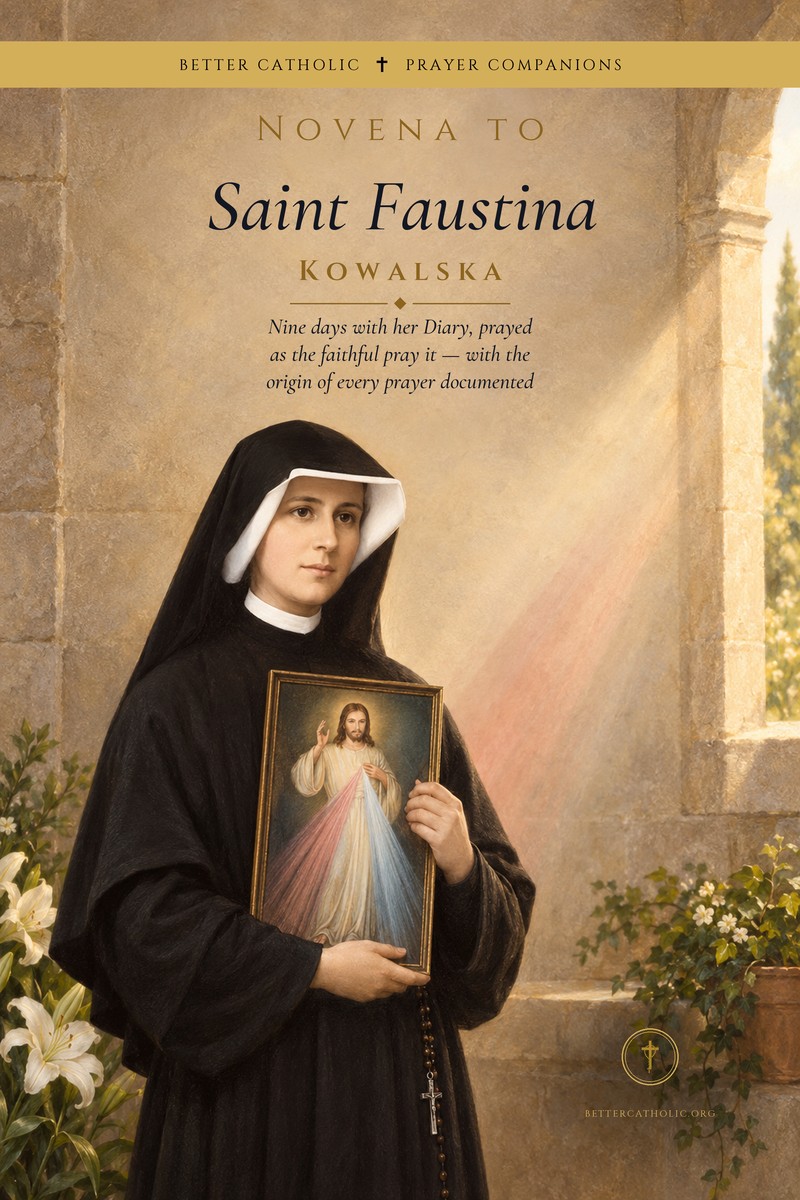
On 22 February 1931, in Płock, she saw Jesus clothed in white, with two rays streaming from His breast — one red, one pale. He asked that an image be painted with the words "Jesus, I trust in You". In 1933, Father Michał Sopoćko became her spiritual director in Vilnius: it was he who encouraged her to record in the Diary everything Jesus asked of her, and who commissioned the first portrait of the Merciful Jesus, finished in 1934 — the image that stands today in chapels and homes around the world.
On 13 September 1935 she saw an angel about to punish the earth; she begged God for the world, and the angel was unable to act. The next morning an interior voice asked her to pray that prayer always, on the beads of the rosary — and from that the Chaplet of the Divine Mercy was born (Diary, 476), the prayer Jesus himself taught her. Saint Faustina died on 5 October 1938, in Cracow, at the age of 33. She was canonised by John Paul II on 30 April 2000, the day the Feast of Divine Mercy was also instituted.
In English there is an official source: the Congregation of the Sisters of Our Lady of Mercy — Saint Faustina's own congregation, in Cracow — publishes the text of this novena on its own site. The Metropolitan Curia of Cracow, with the imprimatur of Bishop Kazimierz Nycz, established four novenas to Saint Faustina in 2003, each drawn from her Diary; this book follows the third, prayed for the grace of childlike trust.
Each of the nine days carries the same structure: the theme of the day lit by a numbered quotation from the Diary (for example, Diary, 1273), the supplication asking Saint Faustina's intercession, the Prayer of Thanksgiving, the Litany of Saint Faustina and the Chaplet of the Divine Mercy, closing with the Our Father, the Hail Mary and the Glory Be. The companion book in PDF carries the whole novena, ready to print and pray alone or with a group.
“The soul that trusts in My mercy is most fortunate, because I myself take care of it.”
It is the word Jesus spoke to Saint Faustina about trust, recorded in her Diary — the notebook where she wrote, by obedience to her spiritual director, the conversations she carried within while living, on the outside, the simple tasks of convent life. It is also the theme of the first of these nine days: not faith without doubt, but the trust of handing over what we carry alone.
Nine days with the Diary of Saint Faustina, a different theme each day, the same structure of prayer from beginning to end.
Each day carries a theme lit by numbered quotations from the Diary of Saint Faustina — the source of everything known about the devotion to Divine Mercy.
Trust, faith, hope, love, humility, contrition, doing God's will — each day with its own supplication, the Prayer of Thanksgiving and the Way of the Day.
The Litany of Saint Faustina and the Chaplet of the Divine Mercy — revealed by Jesus himself to her in 1935 (Diary, 476) — prayed in full, every day.
The whole novena in PDF, ready to print and pray alone, with your family, or with your prayer group, one day at a time.
Enter your best email and we release "Novena to Saint Faustina Kowalska" in PDF right now — ready to be printed and prayed in a group.