
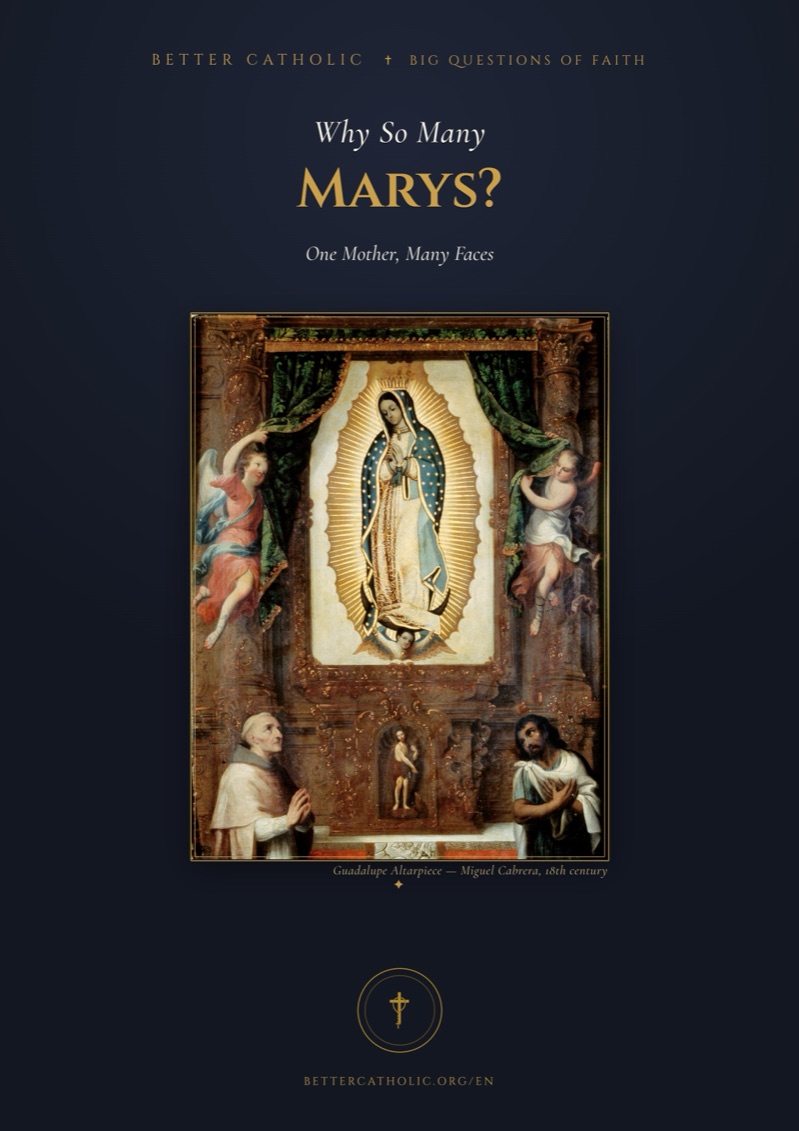
If Mary is one, why so many names?
This book began with a question of my own. The conversation you are about to read — a grandmother and her son-in-law, on a Sunday afternoon — is invented; the doubt it carries is not. Faced with so many Marys — Aparecida, Fátima, Guadalupe, Our Lady of Grace — I too wanted to understand: if Mary is one, why so many names? And when I went looking for the answer, I found it was not gathered in any one place: it was scattered across decrees, commission records, papal bulls, witness depositions, and old books hardly anyone reads anymore.
Faced with my own doubt, I decided to document and compile it all in this book — to share it, and to answer this question for the many who carry the same doubt and do not know where to find the answers. The answers came from a long, painstaking search through primary sources and Church documents: every fact in these pages has a verified origin, and the final section shows where each one came from.
The book unfolds in three parts: Part I lays the foundation — why the titles exist and what the Church actually teaches; Part II walks, one chapter at a time, through the most beloved faces of this devotion — the history, the miracle, and the people of each one; and Part III brings the full answer, and an invitation. May these pages help you recognize, in every face, the same Mother.
“If Mary is one, why are there so many Our Ladies?”
It was Sunday afternoon, after Mass, and the table still held bread crumbs and half-empty coffee cups. It was Dona Cecília’s son-in-law — baptized but away from the Church for years — who finally asked, not to provoke anyone, just out of plain curiosity: "You pray to Aparecida, to Fátima, to Guadalupe... aren’t those three different Marys?" What followed was the kind of silence every Catholic has sat through at least once.
A book to be read straight through — history, document and faith — not a daily prayer manual.
Part I lays the foundation: the difference between the honour given to the saints and the adoration owed to God alone, and the four paths along which every title of Our Lady is born — from Ephesus (431) to the Assumption (1950).
Guadalupe · Aparecida · Our Lady of Grace · Lourdes · Knock · Fátima · Carmel and the Rosary · The Snows · Undoer of Knots. For each one: the history, the miracle, the iconography, and the people who pray before it.
Decrees, papal bulls, inquiry records and eyewitness testimony read in full — not secondhand summaries. Where scholars disagree (the Guadalupe tilma, the Miracle of the Sun), the book shows the disagreement.
Part III walks through the road a case travels before it is recognized — from the 1978 norms to those of 2024 — and why "approved" does not mean what most people assume it means.
For your prayer corner: the Joseph's Studio Our Lady of Grace statue (10.25 in) we recommend — buying through this link supports our evangelization work, at no extra cost to you.
See it on AmazonFor your prayer corner: here's a curated Amazon search for a handcrafted wooden wall crucifix (12 in) — buying through this link supports our evangelization work, at no extra cost to you.
See it on AmazonA rosary for daily prayer: here's a curated Amazon search for a handmade wooden and bronze rosary — buying through this link supports our evangelization work, at no extra cost to you.
See it on AmazonThese are affiliate links: buying through them helps sustain this work of evangelization — at no extra cost to you.
Real comments from our YouTube videos.
I have felt a Great uplifting shift in my daily life since I started this Wonderful St. Michael Lenton Devotion. It's brought Joy, Happiness and a Great sense of relief to my life. I was Sad, Depressed and So Lost before, but now I'm found!
 @carlosgallardo65
I was having a severe crisis of Faith at the beginning of this novena, due to many misfortunes such as illness. Those misfortunes still exist; but my Faith has been rejuvenated, and is much stronger than before.
@mgtowabbott6924I love this novena more than any other I've done in a whole lifetime because it's tough me I'm knotted like a pretzel 😅 I laugh about it for a moment but I'm very serious.
@peggydubarry8180